Archive for category Writing
Better off French? The writer and French children’s Literature.
A friend of mine has a 1-year old whose father is French. When N. was pregnant, I bought Pamela Druckerman’s Bringing Up BeBe for the parents-to-be. I thought it might have some good advice and I wanted to know if it mirrored J.C.’s experiences. I’d read an excerpt in the NYTimes and thought the “method” sounded promising. I have since borrowed back the book to read. I don’t have any children, but I enjoy reading on different subjects. As a writer, you never know when information will come in handy or present an idea for a story.

The son of N. and J.C. Photo by his mother.
All in all, most of the techniques described make sense, partly because, other than being served Camembert at 18 months, the style of parenting appears much like what my mother and other of my parents’ generation would have espoused. It sounds as if French children are far more internally motivated and less demanding of attention than their typical American counterparts. Now, there are caveats. Druckerman herself says what she describes applies mostly to parenting in Paris and, possibly, mostly to a particular socioeconomic class within Parisian society. Although she cites experts and other works, the book is based mostly on observation, not hard research.
What struck me as the reason I might be better off French was the short section on French children’s literature. Druckerman writes of American children’s literature, “…there’s usually a problem, a struggle to fix the problem, and then a cheerful resolution.” She adds, “… every problem seems to have a solution, and prosperity is just around the corner.” (p. 162) French stories, she says, start in a similar vein with a problem and struggle to solve the problem, but the solution doesn’t seem to stick for long and often there is no personal transformation or growth. Her interpretation of the less-than-perfect ending? That life is complicated, and no one is completely good or completely bad.
Of course not all American adult or children’s stories follow this format, but it seems there is a constant demand for growth and change in the characters; at least that is a criticism/question that often arises in critique sessions. Offhand, the only modern French novel I can think of that I’ve read is The Elegance of the Hedgehog. Certainly to me those characters were unlikeable, although I suppose they did change. With this as my only example, I don’t know how well adult French literature follows the model Druckerman describes in children’s books, but I know I would like to be free to write unlikeable characters who don’t necessarily find salvation by the end. And does the ending have to be happy? Most of my endings are more or less neutral, which some might see as “unsatisfying,” although the author Mark Spencer called one mauscript heartbreaking. (Yeah, yeah, it was as part of a class I paid for.)
What I desire is the ability to write “reality” without having to be considered literary. I don’t think my writing is insightful enough,”deep” enough, nor is the prose exceptional enough for that tag, which leaves “women’s fiction” the only category available to me. I’m not sure my writing meets the standards for this nebulous genre/category, defined at findmeanauthor.com as tapping “into the hopes, fears, dreams and even secret fantasies of women today.” The Women’s Fiction Writers Association exists for those who write about “stories about a woman’s emotional journey.” Other than the fact that women are the main characters, I still don’t see how this is different from what was once called mainstream fiction, and that’s why it might have been easier for me if I’d been French!
Writing on Wood from the 1800s in the middle of a Raspberry Haze.
My writing friend B.K. responded to my last post with a post of his own about his writing space. He called his the geekosphere and posted a picture of his desk with all its Disney paraphernalia. A commenter on his post, Marianne Knowles, referred to her own column on writing areas and included a before an after picture of her desk. In her post she referenced a third blogger, Wendy Van Camp, who has a running section in No Wasted Ink on writing spaces.

Before I cleaned up the desk.
The many clean and orderly rooms and desks featured in the No Wasted Ink blog were interesting, but few made me jealous. In some of them no desktop computer or a laptop was in evidence. Other of the spaces made my neck hurt just looking at them, because they looked so un-ergonomic. Although I have my keyboard in a less than ideal spot, I do have a shelf I can pull out that is at the correct height, or used to be when I had a larger keyboard and a different, less adjustable and comfortable chair. This column is a good reminder for me to reevaluate my workstation and keyboard placement. (Please see the wiki article on proper workstation design.)
My husband made my desk out of reclaimed Ponderosa pine beams from the 1800s Manitou Springs Hotel. I wanted a large desk so I could spread out research materials. There is a pullout shelf on one side that holds my laser printer with space under it. Currently that space holds old copies of manuscripts I probably should go through and recycle. The right hand side of the desk is completely open and held the CPU back when I had a Gateway computer. Now I have the boxes my computer components came in stored there.

After the clean up/
Since I also have an ink jet, I have a printer stand next to the main desk. There are cubby holes under it for various grades of paper and an old phone book. (I have to admit that at this very moment, I can’t get either printer to print. Router problem?) The original purpose of the two-tiered catch-all was a place to keep scrap paper for printing, but I don’t generate much of that anymore. It has become the place to stash papers I don’t know what to do with. My bookshelf holds reference books I might use in writing.
The small calendar on top of the bookshelf is from 2011, but it is so lovely I can’t bare to part with it. Also on the shelf is Blue Lloyd, a replacement Steiff bear a friend sent me a year or two ago and some other small figures. I don’t remember where the pigs came from, but I’ve always been partial to pigs. My best friend in high school gave me the pink rock. I also have a collection of post-it notes which I’d love to add to even though I don’t often use them. I plan to buy Scrivener and forget printing manuscripts and marking them up, especially in light of the fact that I CAN’T PRINT. I guess I’ll have to break down and call technical support one of these days, but really, who has the time?

Trinkets on shelf.
I painted my room a yellowy gold but the writing corner is raspberry. I like how the paint job sets the writing area off as a separate part of the room. Some may object to the desk being situated so that I look at a wall instead of out a window. Other than the glare from the window behind me, I don’t mind this at all, especially since I have another desk that looks out said window. Unfortunately, its surface is so covered with junk I moved off this desk or piled on it from other tidying tasks, that it is unusable. Also in this room I have two small bookcases and two matching cupboards with drawers and shelves in which I store scrap paper I no longer use, books that are too large for the shelves I have as well as books I plan to donate, and assorted other stuff, like letters decades and my spring clothes.
Really, this is a lovely writing space, or would be if it didn’t also become the room to store all the stuff no one knows where to put.
How does your writing space impact your ability to get work done?
OMG, There’s a Person in my Writing Space!
What is the plight of the writer who may or may not have another job, whose partner retires/quits a job/is laid off/works at home/takes extended vacations?
I like working part time as it gives me both time alone and a minimally structured day. I write best when there isn’t anyone else in the house. I’m able to concentrate when I don’t expect interruptions. Another advantage of being home by myself is that I can do chores and other daily activities when I feel like it. If I want to get dressed ten minutes before I leave for work, who is to know? I can read while eating lunch and finish my morning coffee while responding to email. Not only is it easier to write without interruptions, but I accomplish more when left to my own schedule.
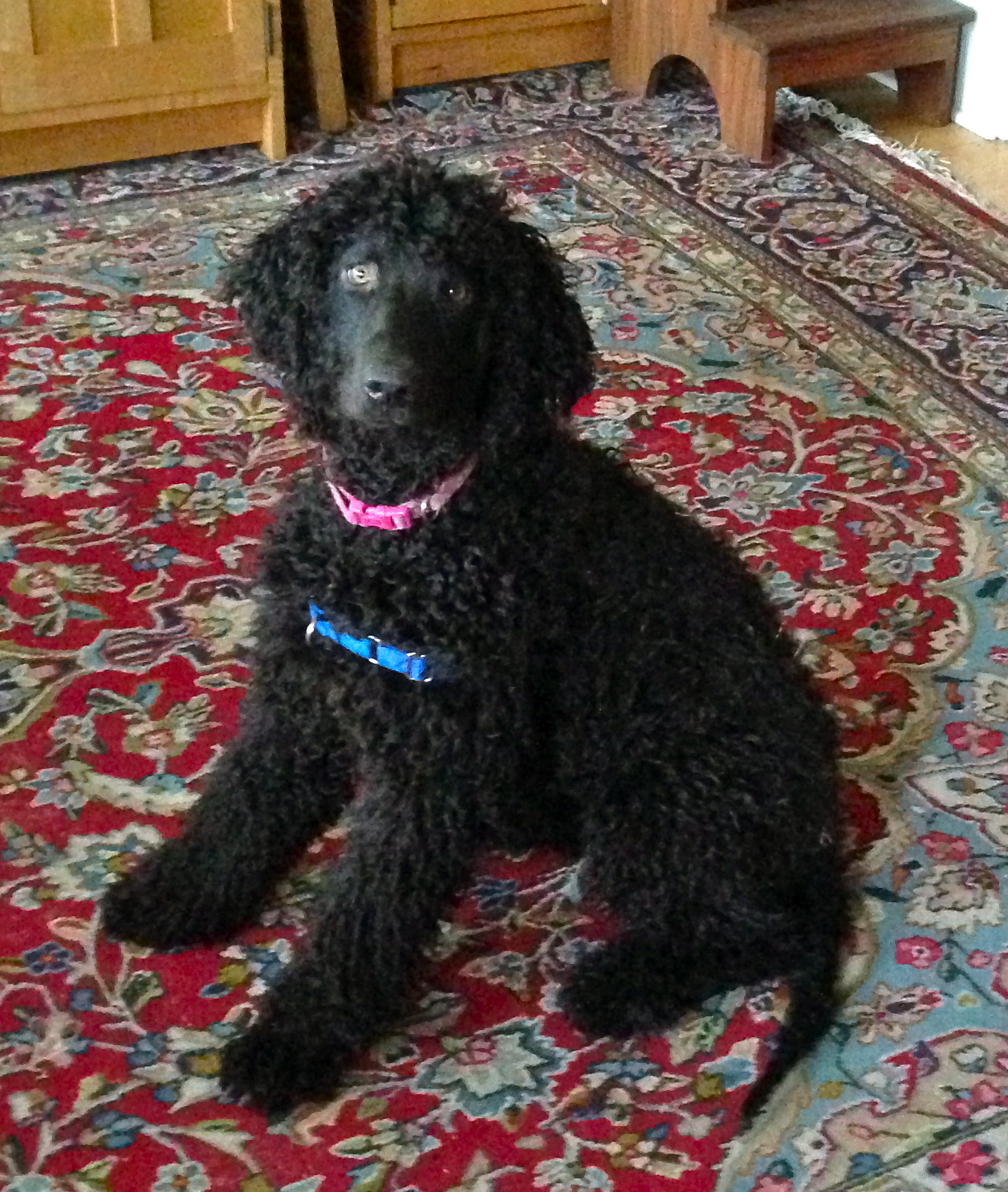
Puppies, too, can be a distraction.
It isn’t that I’m forced to adhere to someone else’s schedule, but harmony seems to dictate that I conform. If you’re eating lunch at the same table, it seems polite to converse, to answer questions, or respond to comments made. This does not, of course, pertain on Sunday mornings when reading The New York Times is my ritual.
Barnes and Nobles Book Blog recently posted Stephen King’s Top 20 Rules for Writers, which included this: 8. Don’t worry about making other people happy. “Reading at meals is considered rude in polite society, but if you expect to succeed as a writer, rudeness should be the second to least of your concerns. The least of all should be polite society and what it expects. If you intend to write as truthfully as you can, your days as a member of polite society are numbered, anyway.”
Once, my husband and I attended the Mountain West Volleyball Tournament in San Diego. A couple, Lobo fans, sat in the bleachers and read during every game when the Lobos weren’t playing and during breaks when they were. We happened to be staying at the same hotel and spied the two of them with piles of books during meals, neither appearing to speak to the other. Although doing all the reading seemed admirable, I did begin to wonder what sort of relationship they had and why they bothered to travel all that way.
Probably people who share an office or are stay at home moms have similar problems. Is having someone around most/all of the time a distraction from your writing? What strategies have you developed to structure your time and writing when someone else is sharing your home or workspace?
World War I, Writing Advice, and a Storybook Ending.
 Luck. A lot of luck is timing and that seems to be true with the story behind this novel, Somewhere in France. I haven’t read it, nor had I heard of it, until I found a link on Twitter. Although I’m not a big historical fiction buff, I am fascinated by World War I and may look for this after I finish the five or six books I’m currently reading.
From the interview above, Jennifer Robson mentions she wrote this novel, queried agents, and was told no one was interested in WWI. She apparently stopped trying to find an agent. When Downton Abbey became a hit, a friend suggested she try querying again. This year is also the centenary of the beginning of WWI. I had wondered at the proliferation of movies and books set in that time period but hadn’t made the connection with 1914. (The Well-Digger’s Daughter, A Young Doctor’s Notebook, The Given Day, others. It seems like I’m encountering these works every other day, although maybe it’s just me since the Dennis Lehane book is years old.)
Somewhere in France is definitely a case where the author wrote what she loved, and a good example of how timing played into interest in her book.
And Then There are the Ones You’ve Lost–Times When We Were Happy
Posted by c2london in Short Stories, Writing on March 3, 2014
Possibly a danger of publishing on the Internet is that things get lost, disappear. Sometimes that is just fine, for instance when something you’re slightly embarrassed by gets published or is published on a site you decide isn’t up to your standards. The advantage of print publications is that normally the editors send you a copy, which you can keep. Some of those old journals might be read someday but there is no easy link to you, the author. But what do you do when you can’t find a published story? I have at least two of those out there in the nether world. One of them was published in The Smoking Poet, which I believe is still publishing, but I can’t find it in the archives. The other, Times When We Were Happy, was in Perigee, Issue 17. This Internet journal ceased publication with Issue 28. With a fair amount of digging, I found it in the deep web. Although I linked it to the title, I also copied and pasted it below, just in case it gets lost again.
 |
|
| Issue 17 : August, September, October 2007 Fiction. |
JUMP TO AUTHOR BIO |
| JUMP TO TOP | CLOSE WINDOW | MINIMIZE WINDOW | MAXIMIZE WINDOWISSN #1551-3130 COPYRIGHT 2007: ALL RIGHTS RESERVED THIS WORK MAY NOT BE COPIED OR DISTRIBUTED WITHOUT THE WRITTEN CONSENT OF ITS AUTHOR |
|

Muse in a Drabble
Posted by c2london in Flash Ficion, Writing on February 24, 2014
While looking through my files, I happened across copies of stories in journals I didn’t remember had been accepted! Not a bad problem to face. One of the finds was a drabble that appeared in The Boston Literary Magazine, Summer 2007. And just for the sake of interest, I include the comment the editor made in her acceptance email: We really loved The Muse Effect and want to include it in our summer issue, which we will be pulling together next week. It was masterful, with such a satisfying ending.
Certainly you might not call it “masterful” but I hope you find it amusing.

Avalon cover
He’d never wanted to be anyone’s muse. That much was clear, but there was something about the elixir of his skin that made her want to strum her guitar and experiment with lyrics.
“Why don’t you want to be my muse?” she asked in the hollow of the night, Roxy Music in the background. She swirled her third Ramos Gin Fizz.
“Why should I? Too much responsibility. I don’t want to be attached to anyone. Find someone else.” He hung up.
Didn’t matter. His very existence ignited her soul, inspired rhythm, inspired rhyme.
No way could he shirk that fate.
New DANGER for Writers!
Posted by c2london in Uncategorized, Writing on February 17, 2014
Recently a friend wrote a blog about plotting vs. pantsing; it appears there is a new “danger” and meaning related to pantsing.

For some time people at my place of employment have been talking about the need to not sit for extended periods of time. I’ve heard hints of this in the popular press, too, and I am a participant in a long-term, nationwide study that asks a question about how many hours a day you SIT. If this anti-sitting research pans out, it appears writers are at risk for ailments not associated with writing in the past. Diabetes. Heart disease. Obesity and probably other ailments as well. Much of the research appears to have come from Australia, with interest shown by many other health care professionals.
Probably most of us think, “Oh, I walk for a half hour a day, or ride my bike for two hours, or exercise on the weekend,” but what this research is saying is that that is not enough and what we need to do is stop sitting for extended periods of time. Exactly what constitutes an “extended” period of time I do not currently know, nor do I know how much time you have to stand up and move around to counteract the effects. Does standing and walking down the stairs to pour coffee provide enough of a break when you’ve been sitting for three hours editing a manuscript? Probably not.
2/20/12 UPDATE: It looks like this could be even more of a concern for older writers. Younger writers turn into older writers on a daily basis, so it most likely is best to establish new habits NOW.
The best advice at the moment might be to set a timer and get up and stretch every hour or so. Dance. If you’re at home, vacuum, run down to the basement to fold the wash, walk to the store. If you can find a place to use your laptop while standing, do that for part of the day. If you’re at writing group, stand up and discuss the writing for at least five minutes of every hour. Just don’t sit in your seat staring at the screen for hours at a time.
This cutting edge research gives new meaning to the word pantser, but unfortunately, it applies to plotters, too!!
Here is the Abstract for one of the original articles from European Endocrinology:
‘Too Much Sitting’ and Metabolic Risk – Has Modern Technology Caught Up with Us?
David W Dunstan,1–5 Genevieve N Healy,1,3 Takemi Sugiyama3 and Neville Owen3
Abstract
Recent epidemiological evidence suggests that prolonged sitting (sedentary behaviour: time spent in behaviours that have very low energy expenditure, such as television viewing and desk-bound work) has deleterious cardiovascular and metabolic correlates, which are present even among adults who meet physical activity and health guidelines. Further advances in communication technology and other labour-saving innovations make it likely that the ubiquitous opportunities for sedentary behaviour that currently exist will become even more prevalent in the future. We present evidence that sedentary behaviour (too much sitting) is an important stand-alone component of the physical activity and health equation, particularly in relation to cardio-metabolic risk, and discuss whether it is now time to consider public health and clinical guidelines on reducing prolonged sitting time that are in addition to those promoting regular participation in physical activity.
Is a Unique Setting Necessary to the Goodness of a Novel?
Posted by c2london in Reading, Uncategorized, Writing on February 9, 2014
 Maybe there are two kinds of posts, those that are opinion and those that require research. The second could also include opinion, of course. After reading a comment by Saytchyn (see comment to previous post) that didn’t actually make it into the comments section for some reason, I decided to write separately about my thoughts on the ten characteristics of a First Class Novel.
What she said was that what met the criteria was subjective, and of course it is, but it also seems as if at least a few of the categories might have more objective measures. For one, transporting us to “unlikely cultures or times” seems as it can be objectively determined, although I’m not clear on the qualifier, “unlikely.” The reader should know if a book is set in a culture, country, or time in which they have never participated. Yes, few of us alive have been to a time prior to 1914. Does that give all historical fiction a point in the 1st class category? The book that Saytchyn mentions, The Bone Key by Sarah Monette, is set in England. If the reader has never traveled to London, does this qualify it as an “unlikely culture”? What if you have visited? What about an English reader living in London? Are they likely to think less of the book if they are familiar with the setting?
Here is the list of the first ten adult fiction books I have listed on Goodreads. Not sure why they are in the particular order they are, maybe by date I rated them? I’ll give a quick assessment of whether or not they meet the culture/country/times criteria.

1. Dancer (Colum McCann)–set in Russia and the world of dance YES

2. Confederacy of Dunces (John Kennedy Toole)–New Orleans of the 1960s. Setting marginally meets the criteria but possibly the characters make it an “unlikely” culture. Yes

3. Let The Right One In (John Ajvide Lindqvist)–Sweden world of vampires. YES

4. Mother of Sorrows (Richard McCann)–suburban Eastern US, 1950s or 60s.This would seem like a no for anyone over 40. No.

5. Chang and Eng (Darin Strauss)–mid-1800 world of Siamese Twins in the US. YES

6. Sense of an Ending (Julian Barnes)–contemporary and mid-1900 England. A very little bit, but how different in England from the US? not really

7. What’s Eating Gilbert Grape? (Peter Hodges) mid 20th century mid-American small town. No, at least if you’re over 25.
8. A Dangerous Woman Mary McGarry Morris  –20th century small town. No, again, if you are over 25.

9. Nobody’s Fool and Straight Man Richard Russo–upstate New York, small town, 2oth century and college town in the Eastern Us. No.
10. A Patchwork Planet (Anne Tyler) –20th century Baltimore. Again, not really.
What does this short analysis say? That I like books with a change in culture/time/country, but it isn’t necessary for me to think a book first class. I know from that sampling that my love of Sense of an Ending was driven by the beautiful writing. The last five were related to the characters. Overall, for me, although a unique, interesting, or foreign setting adds to my assessment of a book, it’s not strictly necessary for me to call a book First Class.
8]Name a “First Class” Novel
 Recently Donald Maass published an article,The New Class System, about his take on the world of publishing in Writer Unboxed. In it he listed classes of novels. I am creating a checklist of his First Class Novel points. My first impression was that few novels would fit in this category, and of course, it probably isn’t necessary for all good novels to meet every point.
Here’s the list, taken from his post:
1. Memorable Characters
a. singular destiny
b. likeable
c. self-aware
2. Unique Premise
3. Instantly “real” story world
4. Gripping plots
a. gripping even when slow
5. Gorgeous writing
6. Surprising themes
a.which are challenging
b. change us or see the world in a different way
7. Break rules
8. Transport us to a different culture or time
9. Teach things we knew little or nothing about.
10. Overall “utterly unique”
For my first attempt at “rating” a book I thought I’d have to use something I’d read in the last year, but when I looked at my bookshelf, I realized I have other candidates. For my first attempt at analyzing a book, I am going to use Lambs of God by Marele Day.
1. Memorable characters. Yes, although I can’t, off the top of my head, name any of the nuns or the priest.They are likeable, although they have varying degrees of self-awareness. And yes, at least two of the main characters, including the antagonist, Father Ignatius, have singular destinies.
2. The premise: a group of nuns live isolated in a forgotten monastery have their new traditions and routines interrupted when a man (Father Ignatius) appears with orders to close their sanctuary. I’ve never read a book with this outlandish premise before, and it is hard to see how anyone else could propose it.
3. Story world immediately real. Yes.
4. Plots that grip. I read it quite awhile ago and plot is not usually a major factor for me, nor are nuns the characters I’d put at the top of my interesting traits/occupations list. Glancing at the book now, I’d say it takes a little (p. 5) to actually get into. I suspect it is mostly slow but still entertaining and interesting.
5. Gorgeous prose. This is another characteristic that I’d have to reread to accurately access. I found this novel hilarious and think comic novels can get away with a different level of good prose.
6. Themes: To definitely decide, reread, but probably yes, although obviously not memorable enough I can spout them now.
7. Breaks rules. Again, this is hard to access since I’m not sure what rules are being spoken to, but yes, a book with one male character set in an isolated spot probably breaks many rules.
8. Cultures and times. My recollection from an interview is that the author made up most of the Catholicism for this novel, but it fits due to the cutoff nature of the group. So in the world of fantasy, yes an unlikely culture.
9. Teaches things. I did have to look up the geography since the author is Australian and I was curious as to the setting. I was also curious as well as the accuracy of the theology. Although I may not have learned much about either in the book itself, the book could be considered a vehicle for learning.
10. Utterly unique. My initial thought was, “Yes, this is unique,” but on reflection, I think it could fit into a genre of science fiction/fantasy–isolated outpost. It might have some similarity to Lord of the Flies, (William Golding) and possibly The Sparrow (Mary Doria Russell.)
I guess I’m calling it as having at least six attributes of the First Class Novel, with three unknown due to the necessity of rereading. The last is a draw since I would have said yes, utterly unique, but on second thought, it does share characteristics with some other stories.
Overall score: 6+
I would love to hear YOUR ideas of First Class Novels and how they rate using this system.
Have YOU used Learning Opportunities on the Web?
Posted by c2london in Online and multimedia learning, Writing on February 3, 2014
 Today I’m embarking on a second Rocky Mountain Fiction Writers’ workshop via yahoogroups, Editing and Revising for Fiction Writers. So far the number of participants seems more manageable than the Heros, Henchman and Sidekick class I took recently. The class length is a bit longer, and there are a few more self-identified mainstream writers. My first problem is to pick a manuscript to work on. The first assignment, though, is to write for twenty minutes without censoring ourselves, so the necessity of picking a manuscript can be put off a day or two.
Meantime, I’ve been checking out some of the online college courses to see how they compare to The Great Courses. As one of the drawbacks of The Great Courses is the cost, I was trying to find free college courses on the web, mostly because I’d heard talk of such. Here is an overview of what I’ve found so far, although I have not taken any of these courses. I did find a few other sites that wanted all sorts of information before you could view offerings; I did not look into their offerings.
Coursera: There are plenty of subjects and classes listed. When I put “creative writing” in the search field, the only class that came up was a Writing Like Mozart class that sounded like it was geared to music.
TED: Under the heading of writing, 33 talks came up. From my brief scan it looked like most of those related to writing were of the inspirational sort and on the short side, making them easy to fit in during down times. They included ones like this: J.K. Rowling: the fringe benefits of failure. This youtube video may be the same or slightly different:
edX.org: has free classes and many interesting ones, although when searching the topic of writing, the ones I found were not currently offered. Another interesting looking class was taught in Mandarin.
This website could also be useful when looking for free online classes: MOOCS: Top Ten Sites for Free Education with Elite Universities. When I followed the links, I came up with UCLA. Unfortunately, all the courses I checked on writing had a fee, the lowest of which was $145.
I hope to have some time in the future to check out a few of these offerings and continue my search for information on the web. I would, though, be very interested in hearing what courses you have tried and what luck you’ve had finding inexpensive or free programs.
 Cuisine of Loneliness