Archive for October, 2014
Chester or Candy? Do Bookcovers Make a Difference?
I am not really a Twitter fan, but sometimes I do run across interesting articles that I wouldn’t find otherwise. Today I happened upon some tweets by Jennifer Weiner. Since they were a bit puzzling, I followed the trail back to what appeared to be the original reference, which was an article related to gender and fiction. The article that evoked the reaction appears to be this, Book By Legal Scholar Gets the Chicklit Cover in Jezebel. It showed both the hardback and the paperback cover of a serious novel and asked if you’d pick up one or the other. Personally, I found them both a bit “chick-lit”-ish and wouldn’t have picked up either. Actually the hardback looked like a YA novel to me.
I found this short piece interesting in relation to a blog I wrote where someone commented that the women’s fiction was mostly defined by the cover. In the comments on the Jezebel post I found a link to another tweet and the resultant piece in the Huffington Post relating to the hypothetical changes in covers given to male and female authors. I’m sure everyone has read at least one of the books that was featured, and the shifts in cover color and design certainly tend to lend credence to the idea that “women’s fiction” is all in the (cover) marketing. Worse, it makes the case that any book written by a woman is forced to appear to be a book of interest only to other women. Check it out. Toward the end of the piece there is a slideshow of alternate covers for around twenty book titles.
Pick one of your own manuscripts or books. What would the cover look like if you were the opposite sex?
For mine, I’m going to pick my manuscript with the most “manly” title. Maybe titles are the first giveaway rather than the actual cover?

Statue of Chester Arthur in NYC park.
I have one titled Man in the Middle. If the book were written by Chester Arthur Cole, the cover might feature the figure of a one-legged man with a cluster of women in one corner and a motorcycle in another and fishing equipment in the third. Candy Apple Cole’s cover would be a handsome man with a surprised look on his face and a perky woman on either side, kissing his face. Probably one or both would be holding a rose and the cover itself would be pinkish red.
With this in mind, how would you see your books illustrated? Would you select one cover over the other if you were a reader?
The Bechdel Test: the Right Question for the Unpublished Author?
Posted by c2london in Friendship, Movies, Writing on October 20, 2014
The WFWA newsletter has provided fodder for a post once again. This time it started with a blog from Writer Unboxed related to gender bias in publishing. I know many are tired of this subject, but this post by Julia Munroe Martin was slightly different and included a link to the Geena Davis Institute on Gender in Media. As many articles on this subject mention, this one discussed the Bechdel test. This test is normally applied to movies, with the basic requirements to pass being at least two named female speaking parts where the characters talk to each other about something other than the males in the movie.

Thanks to Aleska D and FreeDigital Photos.net
As noted, this test is mostly applied to movies, but comments on Munroe Martin’s post suggest applying it to books as well. Some suggested applying it to their own manuscripts. In a book is it “fair” to say that the test is passed if there are two female characters who talk about anything other than men for as little as two sentences? Does it have to be more of a sustained exchange? Do different genres have different likelihoods of meeting this requirement, or is it mostly realistic fiction that should be put to this test? I’m going to start paying more attention as I read and maybe produce a blog on this topic down the road.
For the time being, I’m immersed in critiquing manuscripts. Three of these are from my WFWA critique group, and others are from my mixed local writing group. I’ve read much of the work of one of my partners, and I have little doubt that if put under scrutiny her work would pass, since her characters, both male and female, are trying to solve problems not related to sex or gender but to life, death, and ghosts. A number of the manuscripts I’m reading are historical fiction. One involves a woman realizing she is a lesbian. This is set in the world of rodeo and other topics come up naturally. Another involves an English woman and her maid traveling out West to meet the lady’s husband. These two do talk about their travel and danger. A third is about a young wife and her engineer husband. My recollection is that she exchanges a few lines with a sister when they are children, but I don’t recall her as yet speaking with any other women. A romantic suspense has not as yet introduced the female lead and has been two men talking. In fairness I’ve read sixty or fewer pages of each of these and the tenor of the story very well may change and include other issues.
The last short story submitted by the male of the group involved a family of husband, wife, and two children. The mother and daughter might have had a brief exchange, but this story probably would not lend itself to this kind of analysis due to the tight knit group of characters. Possibly short stories are too brief and feature few enough characters that this test would seldom be passed.
How do my own manuscripts hold up? In the one I’ve submitted to my online group, one of the questions I’m trying to address is friendship. The main character asks others what components they feel are necessary for friendship. This alone should pass the Bechdel test. The problem I’m encountering, though, is that I’m told this exchange is either boring or seems like it doesn’t fit. The question that might be posited by my critiquers is, does this advance the plot?
I read sections of another completed manuscript and it might have problems meeting the test even though there are at least four important female characters. The plot of this particular book involves unplanned pregnancy, affairs, and jealousy, and revolves around the male lead. My two lead female characters are together only briefly, leaving them little time for interaction. The female protagonist does discuss their relationship with her mother. The two also talk about the protagonist’s children, but is this enough to pass the test?
Could it be that “women’s fiction” needs a slightly different test than the one applied to movies?

Side note: when looking for pictures of women talking, most were of either children or sexy, partially clothed women.
How would you rate your writings as far as the Bechdel test? Do you think it is a fair way to look at books, or should some other criteria be used? What might you recommend as more fair? And last, do you find conversations not necessarily connected to the plot, but part of character development, uninteresting or unnecessary?
What Makes You Read On? Does your book exemplify that?
 In September I was assigned three other members from the Women’s Fiction Writers Association to see if we would gel as an online critique group. We’ve had some bumps, and although all three of the other women are excellent critiquers, I’m not sure yet if I’ll continue, mostly due to the heavy reading load.
For our first go-round we tried ten pages a week. This went fast and was easily handled. We all have manuscripts that are in final draft stage, so we are understandably impatient at the snail’s pace of ten pages each a month. This month we’re doing 50 pages each for a total of 150 pages.
I also belong to a local critique group (WURDZ), which meets every other week. Last week I had between 40 and 50 pages to read for that. In the last ten days I read over 100critique pages. I also work part time and have other things to do, including my blog post. Needless to say, I did not get much new writing done. I am not sure I can keep up the pace of possibly 200-250 pages a month.
Both groups include writers of very different genres/styles. One of the women in WURDZ stated she wrote “commercial” fiction. Two others write fantasy/literary fantasy. The online group consists of a historical fiction writer, another more commercial writer of women’s/romance/mystery-thrillers, and the last writes women’s fiction which may be literary.
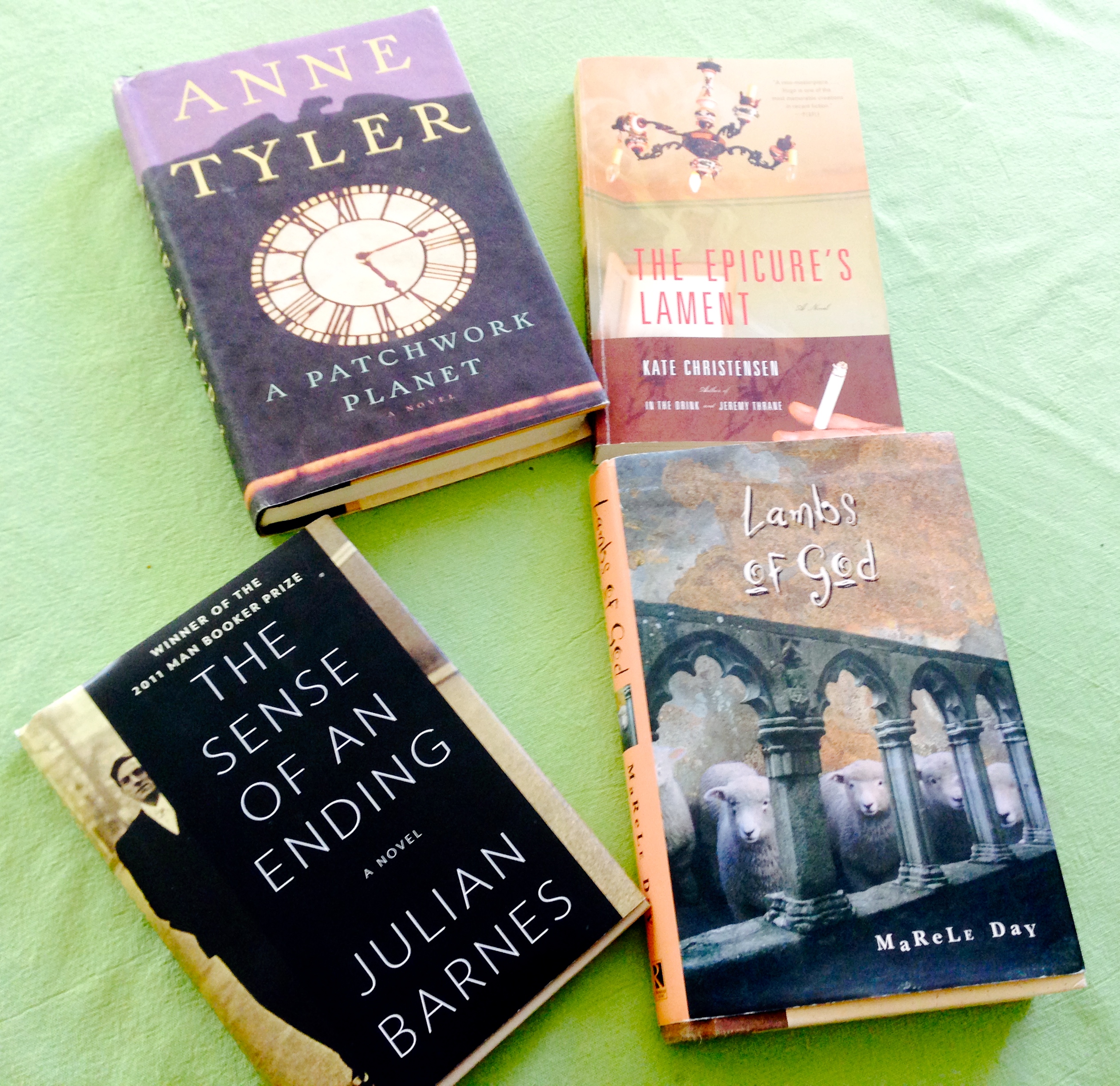
Today one of the online group members posted some openings to bestsellers, all but one of which were a decade or more old. I had read, or started to read, two of the aforementioned bestsellers, The Hunger Games (Suzanne Collins) and Good in Bed (Jennifer Weiner. Also included were Shutter Island (Dennis Lehane) and The Cold Dish (Craig Johnson). I found four books I really enjoyed, two of which were a few years older than the bestsellers. The other two were more current. My four books were A Patchwork Planet (Anne Tyler), Lambs of God (Marele Day), The Epicure’s Lament (Kate Christensen), and The Sense of an Ending (Julian Barnes). At least three of those authors are major award winners.
The woman who posted analyzed why she felt each of the openings worked. Her question come down to “what is going on and why?” Those would appear to be good questions. All four of my openings raised the same questions, but more obliquely. Although of mild interest, the questions weren’t what primarily drove me to continue reading. I believe what all four of mine have in common is voice.
This shouldn’t have been a surprise to me since I’ve written other posts about voice and how it is of utmost importance, but I found it edifying. I’m often trying to write—especially beginnings—to satisfy the perceived demands of agents as expressed by my writing partners, writing conferences, and workshops. Maybe, as a writer and reader these aren’t qualities I enjoy and want to primarily foster. Possibly I’ve set myself an impossible task as it is hard to get an agent to buy on the strength of voice when all they have is my query letter. Possibly they would say voice doesn’t sell. They very well may be correct. It is also highly possible that my voice isn’t good enough to sell a story on that alone.
What, then, are my choices? I could stop writing altogether, but I’m not ready to do that. I could reframe each story to the demands of the market, whatever those shifting demands are. After talking with an editor this summer, I tried to reshape a manuscript to what she was looking for. I soon lost interest. My best option would be to find an agent who specializes in voice and happens to find mine to her liking. This is possible but not necessarily likely to happen.
The last option I see is to switch genre. The first story idea I had as an adult was in the realm of science fiction. I read science fiction as a teenager. I’ll continue to desultorily market some of my other finished manuscripts, but I think it is time to switch. The question is, do I continue with my current critique groups, especially in light of the time they are taking?
Can you identify what makes a book opening most intriguing to you? Does that have much to do with if you read on or not? Does your writing match the sort of opening you prefer?
How Becky Hammon, Ground-breaking NBA basketball Assistant Coach, Can Inspire Writers, too!
Posted by c2london in Inspiration on October 6, 2014

I started attending women’s basketball games at Colorado State University more than two decades ago. Early on in the 95-96 season, I remember saying, “Where’s that little girl? We need her on the court.” That little girl was 5’6″ Becky Hammon, who was recently named the first full-time female assistant coach for an NBA team.
Today is the first day of the Women’s Fiction Writers Association Women’s Fiction Week 2014 workshop. It features presentations from many names in women’s fiction. While reading through the introductory messages from other participants, I found myself getting depressed. They were almost all published or had novels circulating with requests to read. While at the opening luncheon for the 2014-15 season of CSU Ram’s basketball yesterday, another fan alerted me to a recent video with Robin Roberts interviewing Becky. It was just what I needed.
http://espn.go.com/video/clip?id=11582796
Some of her encouraging words: Keep perspective, have an unwavering belief. She mentions figuring out how she can make herself better (workshops/conferences), as well as how can she make those next to her better. (critiquing/writing group)
Advice to young girls: bring passion to everything you do. Have an excitement and enthusiasm to your work and work as hard as you can.
The take away? Becky is on the short side, from South Dakota. She was under recruited to college, which is why Colorado State was able to snag her. She did have a great teammate in Katie Cronin.  Probably both of them helped and encouraged each other to be better. I suspect Katie, along with Becky’s family, was a big supporter of her progress when she–again–wasn’t recruited out of college into the fledgling WNBA.
I was at another pre-season basketball picnic before Becky’s junior year. She was walking around and introducing herself to the fans, saying, “Hi, I’m Becky Hammon.” It was funny because, of course, we all knew who she was. To the list of qualities she listed for young girls to strive for, I would add humility. Also obvious in the video, but not something she mentions directly, is the support and belief from others who are important to you. In this case, her family always showed support. Her parents made the drive from Rapid City to Fort Collins for all her games, and although I’m no longer in touch with either Becky or her family, I’m sure they continue to show her support. Actually, I did talk to another one of her former teammates at that luncheon yesterday and she mentioned that Katie and another teammate where making a video to send to Becky. She also said all the teammates sent words of congratulations and support as well.
Now after watching her inspiring video, I need to tackle that workshop again and look at it as an opportunity to get better so that I, too, can be one of those published writers one day.
Is there a sports figure or someone from another field of endeavor who has words to inspire you?
 Cuisine of Loneliness