How Does a Literary Agent Target an Editor?
Posted by c2london in Uncategorized on December 5, 2013
Here’s a post by the literary agent Linda Epstein on how she targets an editor. I’m exhausted just reading it!
Blog post on how agents (or maybe just I) create a submission list: http://t.co/9a2HXlRNnW #pubtip #querying This one’s for you @C2jayt!
— Linda Epstein (@LindaEpstein) December 5, 2013
How do you target an agent?
Is Attention the Primary Reason You Write?
This morning on Weekend Sunday Edition, Rachel Martin interviewed Daniel Menaker, writer and past fiction editor of The New Yorker and Editor in Chief at Random House, about his new memoir, My Mistake. Although I have since read the transcript of the interview, I originally missed the middle of it and returned to hear him say, “Yeah, I think we write for attention.” My immediate thought was, “That’s odd. I don’t think my main motive for writing is attention.”
Maybe “real” writers do want attention, but I want the story to get attention, not me. Sure, I wouldn’t mind answering some questions about the story or the writing of the story, but that doesn’t mean I want to do it face to face. For me one of the allures of writing is that I can do it behind the scenes and not have to be front and center. Yes, writers who are gracious and entertaining and informative the way Mary Doria Russell was at the recent Readcon event in Greeley are a delight, but it’s hard for me to believe that most writers want to be on the hot seat, being questioned and photographed. Most of the writers I know want to write and publish. I’m not sure I’ve ever heard one of them talk about how they’re writing so they can go on tour or be featured on Oprah or interviewed on NPR. I don’t think one of us in any of the writing groups I’ve been part of have expressed a desire for fame. Publication, yes. The allure of money, occasionally, but most of us who have been in a group long enough seem to give up on the big bucks and just aim and wish for publication.
My next thought was, maybe that’s what I’m doing wrong; I don’t want attention enough. Possibly that thought is related to another blog a writer-friend reposted the other day, The One Thing You Are Doing to Block Your Writing Success. In this blog the author talks about not calling yourself a writer and how that might be harmful to your career. In other posts on her blog she talks about Myers-Briggs type and relates that to writing and writers. I wonder if, in part, my response to her post and my not usually telling people I’m a writer is related to type? Or, in general, not liking attention being called to myself?
Of course, at some level I do desire attention, the attention of an agent, then an editor which will lead to the attention of readers. There is, also, the matter of the blog. Of course I want people to read my blog and comment and respond. I see that more as interaction than as attention-gathering, though. And yes, in the back of my mind I often have a specific person I want to read a particular work, but again, it’s mostly for the work that I desire attention, not me.
I’m wondering if others who write feel this way or if their primary motivation in writing so to gain attention to themselves?
Grit and Writing leads to Success?
Posted by c2london in Uncategorized, Writing on November 18, 2013
Tom HIlbert, the coach of the Colorado State University volleyball team, posted a Weekend Ted Talk. The talk, via The Huffington Post, was titled The Key to Success. The CSU Rams are currently one of two undefeated teams in D-1 volleyball in the nation and are ranked #10. I’m suspecting one of the reasons Tom found this talk interesting is its relation to the team and the fact that they keep finding ways to win when this year had been presented as a rebuilding year. Friday night’s game was played against Air Force, our instate conference foe. The Falcons are perennial bottom dwellers in the conference standings. CSU is 41-1 against them, having last lost in 1982. While watching the cadets battle us on Friday, I turned to the woman sitting next to me and said, “They play with grit.” Even though they had to know they were likely to lose, they kept playing without a hang-dog attitude. One very long rally earned the respect of the crowd and they were given a round of applause.
The aforementioned TED talk suggests that IQ isn’t a good measure of success but grit is. What does it mean to have grit? Merriam-Webster online defines it as “mental toughness and courage.” Dictionary.com includes pluck, an indomitable spirit, and firmness of character. The lecturer, Angela Lee Ducksworth, defines grit as the passion and perseverance to accomplish long-term goals, or working hard to make dreams or goals a reality.
I never feel bad when CSU beats AF, mostly because I know these players have a chance to be successful in other areas of life, partly due to their grit, but obviously, grit in this instance does not guarantee success in volleyball. My question is, does it equal success in writing?
Ms Lee Ducksworth states many talented individuals do not meet with success, just as there are many smart people who are not successful. Submitting writing for publication is the one area of writing that I would agree requires grit. When you are faced with a deluge of rejection, you have to be able to get back up and resubmit. One other quality of grit that is mentioned in the short lecture is that those who demonstrate it do not believe failure is a permanent condition. Definitely a necessary characteristic to have as a writer. Most published authors had to exhibit some amount of grit in order to obtain the state of publication. One of the few successful authors who comes to mind who did not have the grit to continue to seek publication is John Kennedy Toole. Confederacy of Dunces,
the 1981 Pulitzer Prize winner, would be considered successful by most criteria, although the same may not be said for the author since he committed suicide prior to the book’s acceptance. It was his mother who exhibited grit in her determination to get his book published.
What about other aspects of writing? Does it take grit to finish a novel? A short story or poem? Or is the grit in the editing and rewriting? And even if you have the grit, say, to finish Nanowrimo, we all know that 50,000 words does not equate with success in publication. Possibly we could use the mentality that those who are successful have the grit to revise and rewrite to the point that their work is accepted and published. Certainly that is one type of grit, the determination to be published no matter what, and by that definition, anyone who is unwilling to conform to the exacting demands of agents/publishers/genres may not have the grit necessary for publication. Of course it is necessary to be flexible enough to listen to the critiques of others, but to some degree it seems to me that saying that an author who has spent time and effort concocting the best piece of writing of which they are able who is still not able to find a route to publication lacks grit, is an example of blaming the victim. Often you hear that if you are good enough and have worked at perfecting your craft, you will find success. If that is true, then someone who doesn’t find success did not maintain grit long enough.
This unsuccessfully published individual might still have had the grit to finish a novel or other piece of writing, but does having a finished product equate with success?
If you are a talented author with the will to complete a piece of writing and the grit to seek publication, are you guaranteed success? I think there are plenty of us out there who would respond no. What other factors are involved in writing (as in publishing) success and do they require grit in some form?
READCON: an Event for Readers and Writers. It Was All About the Book.

Teeshirt from High Plains Library Event, 11/2/13
A recent article in SALON, Better Yet, Don’t Write that Novel, lamented that NaNoWriMo is a month-long event for writers and doesn’t celebrate readers. Laurie Miller lauds the efforts of some reading challenges as being more rewarding than the intent of NaNoWriMo. Although I mostly agree with what she has to say, I don’t see a problem with people spending (wasting) their time trying to write 50,000 words in a month. I’ve done it before. The results were less than desirable and I ended up with a mess that is difficult to edit into something readable. Many of the comments to this article mention programs that do promote reading such as One City One Book, National Reading Month, Canada Reads, etc. The recent READCON put on by the Highplains Library District in Weld County, CO had something for both readers and writers. Three of the members of my writing group attended together.
The morning featured a number of writing-related sessions. Later in the afternoon a talk on self-publishing and how to do it right was presented by Jessica France from indieBook Library. This hour was an overview of a longer session on the intricacies involved in putting your own book out there and making it successful.
The first event the three of us participated in was a Zine Workshop, introducing us to a new concept. A volunteer from the Denver Zine Library gave us a very brief introduction to zines and allowed us to browse through a representative sample from the collection. Then we made our own. The majority of participants at this small workshop appeared to be high school-aged. Creating our own small booklet utilizing discarded library books and out-of-date issues of magazines was fun. Interestingly enough, the three of us, all writers, used mostly pictures and few of our own words to create ours.
Another event we did not attend involved creating bookmarks and a third was a contest to design the best library in Minecraft. A quiet space for those who where NaNoing was also available.
All of the planned events were free, but many were ticketed. A Steampunk tea–costumes encouraged–looked well attended and as if everyone was having a great time. Unfortunately, we hadn’t planned ahead and were only able to land one ticket. Our lunch also ran over, making us too late to attend. Instead, we toured the Bookmobile, something I hadn’t done since childhood. For at least one of my friends this was the first time she’d been in one. Each of us won a prize–a screen cleaner, a book, or a DVD, just for taking the quick tour. Each branch of the Library District had also created a display celebrating a genre of literature. Most of the displays included a small treat, an interactive feature, and a book list or two.
Sessions on establishing book clubs, a “whodunit” webinar, photo contest, reading recommendations, and more were presented for readers. The highlight of the event, though, were the talks by authors, including a local authors’ panel. This panel ran the gamut from a nationally known bestselling author to a self-published YA author. Two guests of honor were Craig Johnson, author of western mysteries, and the multifaceted Mary Doria Russell. This was what had interested me in READCON in the first place. I’d read The Sparrow when it came out as well as the follow-up book. After that I was vaguely aware that she’d written other things and had the idea she was writing historical fiction, but I’d never bothered to check out her other books. She was a delightful and funny speaker, as well as a gracious signer of books. I wished she was, if not in my writing group, at least my friend. Her talk about Doc Holiday convinced me to buy the book, Doc.
The last event we attended, and the other main reason we decided to make the trip to Greeley, was the book signing, which was accompanied by samples from two local breweries. I hadn’t expected the beer to be free. Since it was, we were able to purchase another book or two from more local authors. I enjoyed both the amber and chocolate porter samples from Wiley Brewing. 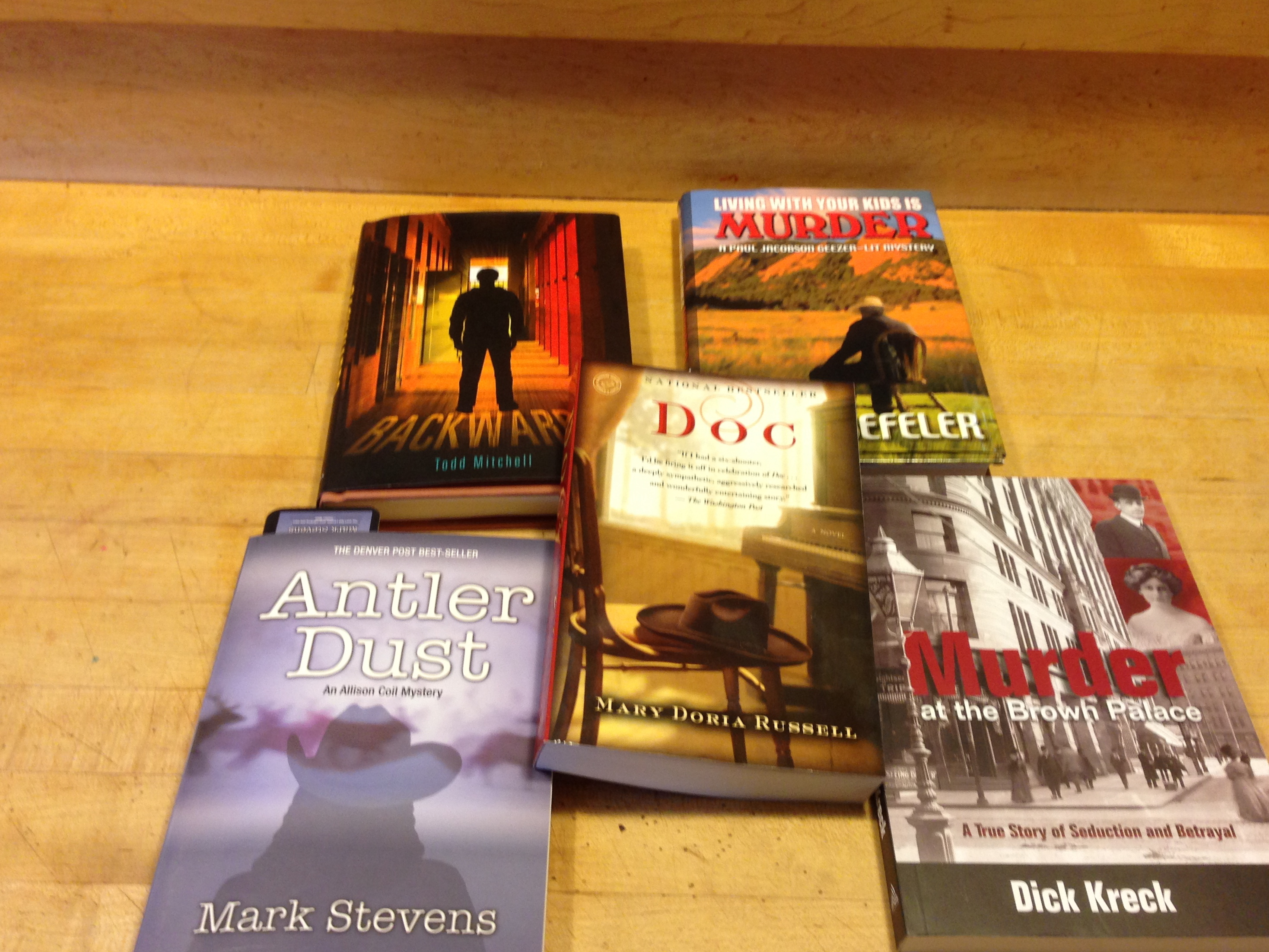 Books pictured: Doc by Mary Doria Russell. Murder at the Brown Palace by Dick Kreck, Antler Dust By Mark Stevens, Backwards by Todd Mitchell, Living with Your Kids is Murder by Mike Befeler.
I attended two writers’ conferences as well as a writers’ retreat this year and in many ways I enjoyed this event the most. Possibly it was because it was free. The shortness of it might have helped, or the fact I attended with two friends and met at least two new local writers. Possibly it was the lack of pressure; no agents to worry about impressing. As a non-overly gregarious introvert, I often watch as others butt into my attempt at conversation or negate my tentative beginnings. There was none of that here. It was all about the book. The lines to have books signed were either nonexistent or very short. Mary Doria Russell was completely approachable and gracious in responding to questions. (At an SCBW (not yet i) conference I once stood in a long long line to have a book signed only to have the author, who was chatting with a friend the whole time, look up when I got to her and say, “Oh, I’m not signing anymore.” I’d really admired her writing, but her less than friendly dismissal completely reversed my feelings. Possibly I should have blamed the organizers. They could have announced that after a certain time/number of people/some other marker the author would be done. I agree she had to eat lunch; the problem was the arbitrary and almost nasty way she decided to stop that bothered me.)
The High Plains Library District is to be commended for this fine program. Many of us will be looking forward to attending again next year. Oh, and the teeshirts were great. I loved the color on the front and the design on the back and that they were heavy and black.

Facebook, Friends, and Writing
Posted by c2london in Friendship, Writing on October 24, 2013
For me, one sign of a good workshop or conference is making a new friend. Pre-Internet I meet a woman at the first conference I attended, the Southwest Writers’ Workshop. We reconnected at the yearly conference. Between times we exchanged manuscripts. By the time email became the main mode of communication, we’d lost touch. She divorced and I don’t have enough information to find her again.
In 2008 I participated in an online writing workshop. The teacher suggested we join Facebook. So I did.At first my only friends were the other members of the group, as well as a friend’s daughter who felt sorry for me when I told her every time I opened the site it announced, “You have no new friends.” Probably those of us in the workshop were too busy critiquing and discussing on the workshop site. Side conversations were via email. When the workshop ended, a few of us kept in loose touch through Facebook. I met two of the workshop members at AWP in Denver. One of them, M.E. Parker is the founder of a well-received photography and writing journal, Camera Obscura. Even five years later I sometimes exchange critiques with another member.
I met at least four of my Facebook friends at a conference/retreat held at a dude ranch outside of Tucson. I’ve met up with two of them at other conferences and occasionally interact with them on Facebook. At this Springs’s Pike’s Peak Writers Conference I met a woman who became the newest member of our writing group. During the recent RMFW Conference I added three writers to my list of friends.
My most recent foray to a retreat yielded twitter contacts, no new friends. This small retreat was held in a lovely mansion hotel on Long Island. Meals were included and were served off a menu; not your usual banquet chicken! About eight years ago I attended another small workshop and thought I had not come away with any new contacts but last month I did reconnect with another participant at RMFW. Possibly somewhere down the line I will be in contact with some of the other writers from the Writing and Yoga Retreat. This event is sure to grow and include more participants in years to come.

The Glen Cove Mansion, home of the Writing and Yoga Retreat
The lack of a compatriot at this last retreat might have been, in part, due to the small size of this retreat. This was the initial foray of the two leaders into putting on a retreat. The likelihood of making friends might depend on a critical number of participants. The Tucson workshop had been small, too. There were 12-16 of us. I garnered four friends from that group. This last retreat had a mere five women, plus the two leaders. Three of the women were close in age and bonded easily. One of the other participants was related to one of the leaders, and both leaders were already friends. This left me as the outlier with no natural partner and although I am following or being followed by four of the six others, I feel each is a tenuous connection at best.
Not long ago I ran across an article, Whether Facebook Makes You Lonely Depends on How You Use It. I posted this on my wall and asked my friends which way they felt. Those who commented said happier. My response would be mixed. Probably the largest proportion of my contacts consists of high school classmates, whom I “collected” for a recent reunion. The rest are workmates, neighbors, a few people from college, my “real life” friends, and sundry others. Some posted often in the past but have either gotten bored and moved on or now interact with a select group that doesn’t include me. Many never comment or post status updates. A large number post only lost cats, recipes, photos of dogs, and quotes of others. Some are lurkers. A few routinely send holiday and birthday greetings and then sink back into the sand of anonymity. Possibly I shouldn’t expect more; this may be who they are in their everyday lives. Maybe this lack of interaction is related to differences in personality type, but I find the lack of response and interaction frustrating. Often it makes me unhappy and I wonder why I bother checking in.
But when it comes to my writing connections, I find Facebook both useful and entertaining. Many friends post interesting articles related to writers, writing, and publishing. Recently one acquaintance reviewed a book she found in a used bookstore that sounds right up my alley. I plan to look for it. I’ve asked for book recommendations and help with problems related to the mechanics of writing, computer glitches, and story concerns. I belong to at least one page that lists calls for submissions. My writing group created a private group to conduct our business. We’re currently doing our October short story writing month and sharing prompts.
Because of its usefulness to me as a writer, I’ll remain a dutiful user of Facebook until something better comes along. Google+? If you know of something, let me know, but until then, I hope to continue to expand my circle of writer-friends.
Sigh. Vietnam Veteran Story
Posted by c2london in Short Stories on October 13, 2013
I was working on this story when I decided to enroll in The Literature of the Vietnam War class at Colorado State University, taught by John Clark Pratt. I hadn’t been an English major in college and only subsequently did I take a few undergraduate literature courses and graduate writing classes. This was one of the best classes I ever took. We read numerous books I’m sure I wouldn’t have encountered if I was reading on my own, such as Into A Black Sun. (Takeshi Kaiko)
We also read The Quiet American (Graham Greene), a novel by a Vietnamese officer, which, to my knowledge, is not available. We did not, notably, read Going After Cacciato. I don’t remember if there were any veterans in this class, but there was a woman who had been a nurse who brought orphans our of Vietnam. One of the requirements of the course was to write a paper. I asked if I could instead submit a short story. Dr. Pratt agreed, and I think I can say with assurance that he thought highly of the story. He encouraged me to join his graduate workshop the following semester, which I did.
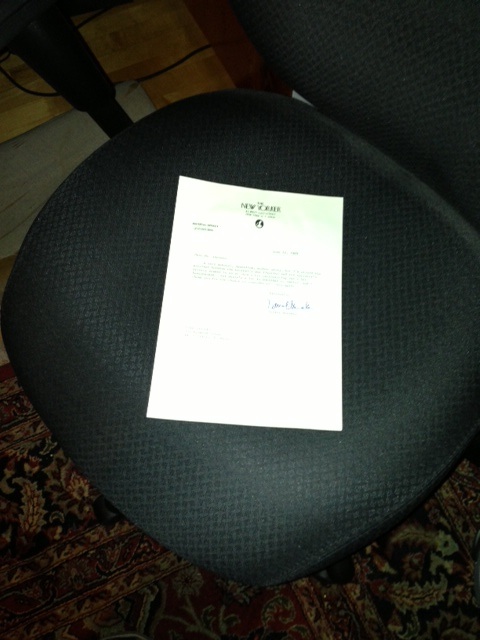
When the story was ready to send out, I decided to start at the stop. Why not? So I sent it to the New Yorker. And then many more until finally, not quite twenty years later, it was accepted at this now defunct Internet journal. http://noneuclideancafe.com/issues/vol3_issue2_WinterSpring2008/cole.htm. Although I was happy to finally have it find a home, in many ways it was a comedown from my New Yorker submission. The text of the personal rejection follows. I since changed the title.
June 12, 1989
Dear Ms.—–, A very natural, appealing, modest story, but I’m afraid the parallel between the brother’s war fixation and the narrator’s divorce seemed to us at once a bit unconvincing and a bit heavyhanded. But there’s a lot in SOLDIERS to admire, and I thank you for the chance to consider it. Try again.
Sincererly,
Daniel Menaker
Partial Reading List, Literature of the Vietnam War
The Quiet American, Graham Greene
Into a Black Sun, Vietnam 1964-65 Takeshi Kaiko
The Laotian Fragments, John Clark Pratt
Parthian Shot Loyd LIttle
The 13th Valley John M. Del Vecchio
Paco’s Story Larry Heinemann
No Bugles, No Drums Charles Durden
One Very Hot Day David Halberstam
One to Count Cadence James Crumley
Bridge Fall Down Nicholas Rinaldi
Blog Post #4 is the True Test
Posted by c2london in Uncategorized, Writing on October 7, 2013
This should be my fourth Social Media Monday and my fourth blog post. The other two don’t count since I was trying to put the stories under the tab I wanted them in, not write a blog! I’ve started two other blogs. Both bogged down after entry #4, and I’m curious to see if that will happen with this one, too.
I had wanted this blog to be my attempt at having the necessary social media platform many in the publishing industry espouse. I have to admit, though, that I’m somewhat discouraged since it feels like the novel with the same name as this website may be going nowhere. As in out to agents, not as in finished. It’s finished. It’s ready for a final copy edit, then out, but I’m despairing of having a place to send it. The reason for this is the subject of the post I want to write but unfortunately, it is going to take more time than I have today, even though I started thinking about it years ago and wrote part of a draft yesterday.
Back to work!
First Internet Publication
Posted by c2london in Flash Ficion on October 5, 2013
Not my first publication but the first on the Internet. It’s kinda old.
Learning From the Setter
Posted by c2london in Flash Ficion on October 5, 2013
Since I’m watching the Washington/CU volleyball game, it seems like a good time to work on getting this website set up. The following story was inspired by the sport of volleyball and a exasperating fan.
 Cuisine of Loneliness