Archive for category Short Stories
The One Story Workshops
Posted by c2london in Inspiration, Short Stories, Writing on February 28, 2016
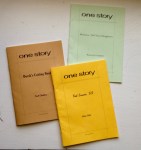 Shortly after the WFWA workshop ended, I started the first of three One Story workshops. The first, Write a Short Story with Hannah Tinti presented a method to write a complete short story in a few days. It was fun, although I think it might have worked better if you had characters or a situation in mind before you started. I did end up with a complete but short piece, although I’m not sure how much I really like it.
For me, the platform the class used was a bit overwhelming. I have no idea how many people were taking this class. People posted the new bits of their story and others commented, but this seemed to be a jumble, with so many storylines and so many people, it was hard to keep track whose character was in which story. Eventually I more or less randomly chose a few participants to focus on. If others were kind enough to comment on my submissions, I returned the favor. This soon narrowed the number of people I was following to a more reasonable number, although it was still a jumble with no real flow that I could determine.
I did figure out a few other “tricks.” To get your submission to appear near the top of the list, it was good to comment on everyone’s comment, even if only to thank them. Eventually I also figure out there was a way to mark all the comments you had read so you could see what was new. And of course, the best way to get others to comment was to comment on their submissions.
The next class was Become Your Own Best Editor where the participants read an initial submission, subsequent editorial comments and the changes the author made to the piece up through the final printed version. There were probably fewer participants in this class and in this case it wasn’t quite as necessary to keep the continuity with who said what where. My personal take-away was I really don’t want to be an editor because I was bored rereading the same story over and over. Hannah Tinti and the other editor involved both made insightful comments that apply to most any story rewrite. This workshop has been offered using a different story published in One Story with a different editor so could be taken a second time.
From Character to Story:A Craft Intensive with Editor Patrick Ryan also offered some useful tips. By this time I was familiar with a number of the other participants and it was easy to look for them and read their comments.
The next offering from One Story starts on March 11, My Evil Twin is an Editor, or What the Soaps Taught Me About Writing.
These classes have varied in their helpfulness, but are good for connecting with other writers. Probably which class you’d find most insightful would depend on where you are in your writing career. It should be noted that many known names and people with much success enroll in these courses as well as people who have not written much.
I’m not wild about the platform and the number of participants, but if chaos doesn’t bother you or you don’t want to interact, these may work equally well for you. For some people the amount of work/number of lessons in a short period of time can be difficult, too.
No, No, Nano: Why November Doesn’t Work for Me.
Posted by c2london in Inspiration, Short Stories, Writing on November 2, 2014
Reasons November is not a good month for NaNoWriMO

- Thanksgiving,
- Especially if you are hosting a dinner
- Or have company for the weekend,
- And even worse if you are traveling.
- Volleyball is still going, including Selection Sunday
- Basketball gears up

- Really bad if you have men’s and women’s tickets

- And if you’re one of those crazies who also has football tickets? Exactly when would you have time to write?

- And there’s NFL games, NBA games, and hockey, too. At least I think that last is true.
- Some Nanoers gather to write, and probably eat, but since the month is bracketed by Halloween candy and Thanksgiving, that in itself might not be a good idea.
- There’re all those craft shows for holiday giving, and
- That day after Thanksgiving where so many shop.
- Start of Christmas cookie baking.

- Other holiday planning and doing.
- And it’s close to the end of the semester for many schools.



There are plenty of good reasons to take the challenge. For instance, this site lists 14 published books written during Nano. There are sites that give you ideas of how to make this month productive, as well as this blog by WFWA and RMFW member, Jamie Raintree, with ways to convert this month into a productive year.
Even with evidence that this month truly does work, I’m not participating. When I’ve attempted this exercise in the past, I’ve ended up with a mess. I did “win,” but I’m still trying to untangle the knots from four years ago.
My writing group has tried some alternate “months of writing.” We’ve picked a month with the idea of writing a story a week. Each week one of us emailed prompts. Although I haven’t checked with the others, I know at least two of the stories I produced have either been published or are slated to come out soon. This shorter, more focused exercise works better for me.
Are you Nanoing? How has the process worked for you in the past?
Grading My Conference Experience
Posted by c2london in Friendship, Short Stories, Writing on September 8, 2014
I attended Colorado Gold, the 30th edition of the Rocky Mountain Fiction Writers’ conference this past weekend. Although I could get many other posts out of the conference, I’m going to start with grading my own experience.
Networking: (D- ) After the Crested Butte conference in June I had 500 business cards made. I handed out THREE. Although I chatted with a few people, I made no new contacts or even Facebook friends.
Hotel Location: (A ) Easily accessible from I-25 and N of the Denver metro area, which made the drive easy for those of us coming from the north. Not sure if people driving south felt the same way!

The hotel did have a spectacular view, although this is not it.
Hotel Reservations: (D- ) I never received a confirmation. When I called to check on this, I was assured by both the reservation service AND the hotel itself that I did NOT have a reservation. They offered to rebook me for $185 a night, seventy dollars over the conference rate! I made other plans. The only reason I’m not giving the hotel an F for this is they sent me a pre-arrival notice prior to the weekend so I was able to cancel the reservation I didn’t have before I was charged.
The Hotel Facilities: (C- to D) I’m not sure how a hotel in 2014 can get away without having Wifi in the conference rooms. Even worse, there was limited audio-visual ability. Most of the conference rooms were small. Many sessions held in those rooms required people to stand. Even after chairs were added, it was sometimes difficult to find a place to sit. The doors to the rooms opened at the front, making an early exit or late entrance noticeable and noisy.
Food: (C+) The rolls were good. Why there weren’t water pitchers on the table, I don’t know. The luncheon buffet tables were whisked away almost before everyone was served. The hotel restaurant had some interesting offerings, but my pinon-crusted French Toast featured nary a pinon.
Beverage Service: (B ) Four dollars for a club soda? Really? Last year I ordered club sodas and they gave them to me for free. Maybe it isn’t fair to compare last year’s hotel to this one. Water was offered in all sessions, which was fine, but again, the hotel last year gave us rootbeer floats for free! Okay, no more comparing. On the plus side, this hotel did supply real glasses for serving the water.
Speakers and Banquet: (B ) I suppose if you’ve been to a conference of almost any sort, you’ve sat through the messages and speeches and jokes. Unless you’re part of the inner group, they aren’t really of much interest.
The Running of the Conference: ( A) This is run totally by volunteers, and they do an exemplary job. There were a few glitches, some foreseeable, others possibly due to the layout of the hotel. Some might have been due to the unreasonable expectation that everyone was staying at the hotel and attending all functions. Most were minor, and if not self-correcting, easily explained by asking questions.
Other stuff (No grade): I overheard complaints about the lack of a rating sheet for each workshop. The conference chair did specify everyone would receive an email to a survey monkey in the next few days. This seems sufficient since it saves paper, many people don’t fill out surveys anyway, and the results will be easier to compile.
The Important Part: the Workshops
Probably your perception of the workshop offerings depends on how many conferences you’ve attended in the past, your level of writing experience, and your interests, as well as the ability of the presenters. I do know one person who said she was attending as much or more for the networking as for the workshops, but to me that is an expensive way to make contacts! I consider a conference a success if I come away with a new friend or contact, but the actual content of the conference is still of utmost importance.
The Friday morning add-on sessions didn’t interest me this year, either due to the subject matter or the presenter. There were small group critique sessions with agents and editors. Normally I might have availed myself of these. If I attended one of these, I would have wanted to have stayed overnight to make sure I didn’t get caught in rush hour traffic.That effectively would make the cost of the critique session more than $150 as I would have had to pay for the session, an extra night of lodging, dinner, and breakfast.
I was most looking forward to the Writing with Scrivener class. It was good, but I would have preferred to have spent all that extra money mentioned above in order to attend a longer session.
My other main objective during this conference was to acquire more social media knowledge. I was disappointed in the few offerings. A local writer commented that she felt there weren’t that many offerings, because most people already knew all they needed or weren’t interested. I attended Marketing for the Introverted Writer, which touched on social media, as well as the two dedicated classes, Websites and Social Media and How to Manage Your Author Social Media Platform in 30 Minutes a Day. Both classes offered a plethora of information on what to use. New, useful websites were mentioned and useful handouts provided. What I was looking for, and what I overheard many others say they needed, were the nuts and bolts of how to make these techniques work. This workshop was missing from the conference schedule. Again, I would have been willing to pay extra for an in-depth explanation. Another option would have been a series of free sessions on each of the various social media outlets. In truth, this might have been very difficult with the limited audio visual and lack of Internet connectivity.
Up until late Saturday afternoon, I would have said the conference wasn’t really worth the cost, but finally the session on science fiction got me excited and smiling. Although I still might not have thought I’d gotten my money’s worth if I’d gone home at that point, at least I would have been happy.
Unfortunately, Sunday morning had the most enticing classes. Why unfortunately? Because most of them overlapped. I could have attended any of three of the 8 am sessions, but two of my critique group members had stories in the RMFW’s anthology, Crossing Colfax. I had agreed to attend the panel discussion on the formation of the anthology, which was concurrent with the other three sessions of interest. I did enjoy the panel and hearing the impetus behind the accepted stories.
The speaker for the New Golden Age of Short Fiction, Thea Hutcheson, was a dynamic presenter. Her enthusiasm was contagious and her insights and ideas useful. Literary Pulp: What it takes to Write Literary Genre Fiction was my last session of the conference. It might not have completely filled the premise of that title, but the speaker, John Blair, was interesting and entertaining. He engaged the audience and we left on a positive note.
At the 2013 conference I met Najah Lightfoot. This year she was presenting. I planned to attend her session, Show and Tell: Magic and Magick Tools of the Trade. I wanted to be a supportive friend and also thought I might glean some interesting tidbits I could use in a story. Instead of that small expectation being met, I thought the first half of Najah’s session had to be one of the most interesting and best presentations of the conference. As I was also looking forward to the session mentioned above, I only attended half of the magic session, but that half was moving and wonderfully presented. I hope that I can someday listen to the rest of her session. Thank you, Najah.
If I were to actually grade the sessions, I would say the Sunday sessions brought up the average. Since they were last, the impression I was left with was of success. I’d have to give the overall conference an A. Okay, to be true to my curmudgeonly self, I’d give the overall sessions an A-.
Were you there? What did YOU think? What was your favorite session?
And Then There are the Ones You’ve Lost–Times When We Were Happy
Posted by c2london in Short Stories, Writing on March 3, 2014
Possibly a danger of publishing on the Internet is that things get lost, disappear. Sometimes that is just fine, for instance when something you’re slightly embarrassed by gets published or is published on a site you decide isn’t up to your standards. The advantage of print publications is that normally the editors send you a copy, which you can keep. Some of those old journals might be read someday but there is no easy link to you, the author. But what do you do when you can’t find a published story? I have at least two of those out there in the nether world. One of them was published in The Smoking Poet, which I believe is still publishing, but I can’t find it in the archives. The other, Times When We Were Happy, was in Perigee, Issue 17. This Internet journal ceased publication with Issue 28. With a fair amount of digging, I found it in the deep web. Although I linked it to the title, I also copied and pasted it below, just in case it gets lost again.
 |
|
| Issue 17 : August, September, October 2007 Fiction. |
JUMP TO AUTHOR BIO |
| JUMP TO TOP | CLOSE WINDOW | MINIMIZE WINDOW | MAXIMIZE WINDOWISSN #1551-3130 COPYRIGHT 2007: ALL RIGHTS RESERVED THIS WORK MAY NOT BE COPIED OR DISTRIBUTED WITHOUT THE WRITTEN CONSENT OF ITS AUTHOR |
|

Sigh. Vietnam Veteran Story
Posted by c2london in Short Stories on October 13, 2013
I was working on this story when I decided to enroll in The Literature of the Vietnam War class at Colorado State University, taught by John Clark Pratt. I hadn’t been an English major in college and only subsequently did I take a few undergraduate literature courses and graduate writing classes. This was one of the best classes I ever took. We read numerous books I’m sure I wouldn’t have encountered if I was reading on my own, such as Into A Black Sun. (Takeshi Kaiko)
We also read The Quiet American (Graham Greene), a novel by a Vietnamese officer, which, to my knowledge, is not available. We did not, notably, read Going After Cacciato. I don’t remember if there were any veterans in this class, but there was a woman who had been a nurse who brought orphans our of Vietnam. One of the requirements of the course was to write a paper. I asked if I could instead submit a short story. Dr. Pratt agreed, and I think I can say with assurance that he thought highly of the story. He encouraged me to join his graduate workshop the following semester, which I did.
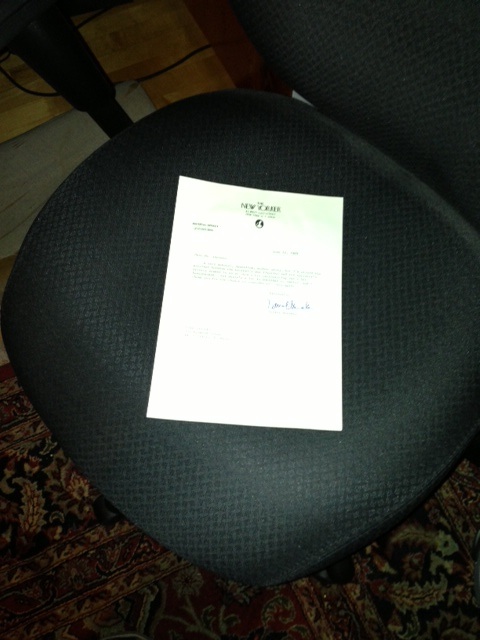
When the story was ready to send out, I decided to start at the stop. Why not? So I sent it to the New Yorker. And then many more until finally, not quite twenty years later, it was accepted at this now defunct Internet journal. http://noneuclideancafe.com/issues/vol3_issue2_WinterSpring2008/cole.htm. Although I was happy to finally have it find a home, in many ways it was a comedown from my New Yorker submission. The text of the personal rejection follows. I since changed the title.
June 12, 1989
Dear Ms.—–, A very natural, appealing, modest story, but I’m afraid the parallel between the brother’s war fixation and the narrator’s divorce seemed to us at once a bit unconvincing and a bit heavyhanded. But there’s a lot in SOLDIERS to admire, and I thank you for the chance to consider it. Try again.
Sincererly,
Daniel Menaker
Partial Reading List, Literature of the Vietnam War
The Quiet American, Graham Greene
Into a Black Sun, Vietnam 1964-65 Takeshi Kaiko
The Laotian Fragments, John Clark Pratt
Parthian Shot Loyd LIttle
The 13th Valley John M. Del Vecchio
Paco’s Story Larry Heinemann
No Bugles, No Drums Charles Durden
One Very Hot Day David Halberstam
One to Count Cadence James Crumley
Bridge Fall Down Nicholas Rinaldi
 Cuisine of Loneliness